Mechanized SPT
Percussion sounding (Standard Penetration Test) with mechanized hammer actuation, following geotechnical investigation practice. It provides the penetration resistance index (NSPT) and disturbed soil samples.
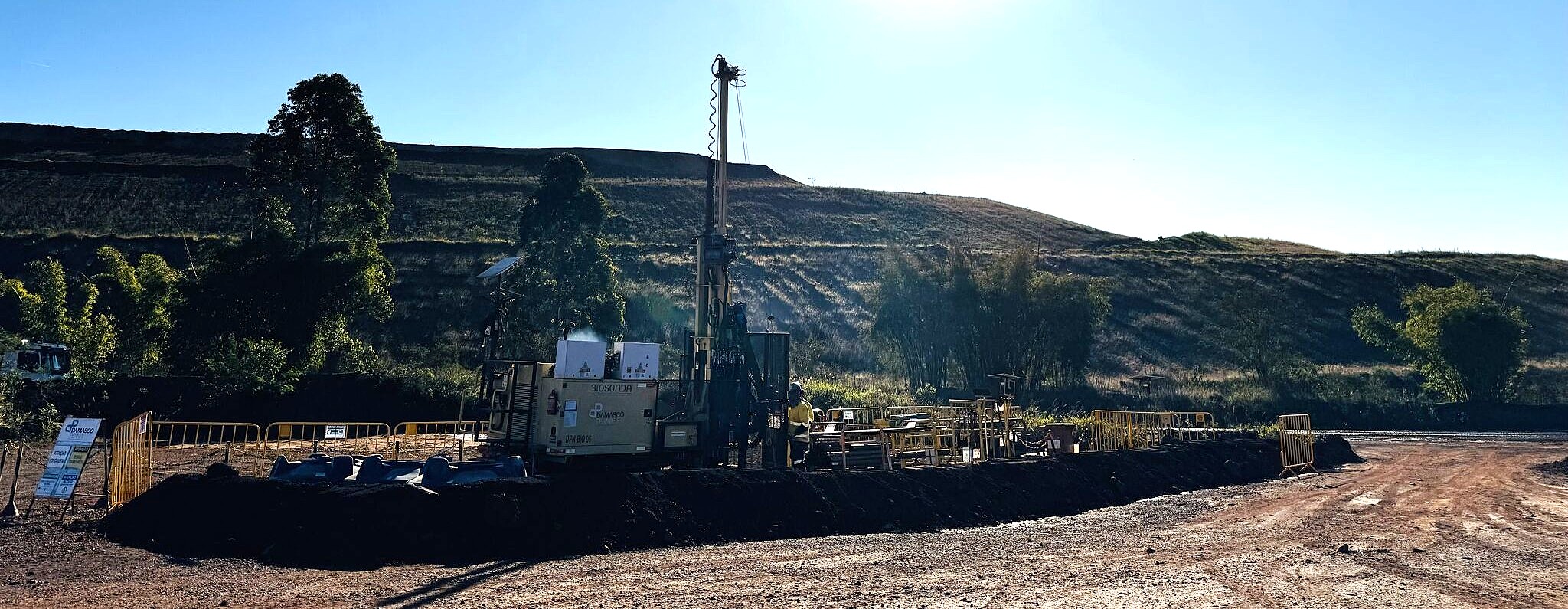
What a hydraulic drilling rig is, what the sounding methods are, and which technical criteria to use to choose the right rig for each application.
A hydraulic drilling rig — or sounding rig — is a hydraulically powered machine used to drill and investigate soil and rock in geotechnical and environmental drilling. Choosing the ideal model depends on the drilling methods required, the target depth, the site access and the technical service available. Biosonda is a Brazilian manufacturer of hydraulic drilling rigs, based in Itapevi (SP), with its own engineering, manufacturing and technical service.
The hydraulic drilling rig is the machine that carries out subsurface investigation. Unlike older mechanical rigs — driven by clutch and cable —, the hydraulic rig uses pumps, cylinders and hydraulic motors to generate rotation, torque and feed force (pull down) and retraction (pull up) in a controlled way. This brings more productivity, repeatability and operator safety.
In practice, the term covers equipment ranging from compact units for restricted areas to heavy tracked rigs. What defines the application is not only the size, but which drilling methods the equipment can perform and up to what depth and diameter.
Before comparing different models, it is worth understanding what each method does — because the method determines which rig you need.
Percussion sounding (Standard Penetration Test) with mechanized hammer actuation, following geotechnical investigation practice. It provides the penetration resistance index (NSPT) and disturbed soil samples.
Cone penetration test (and piezocone, in the case of CPTu), by continuous pushing. It generates a detailed subsurface profile without retrieving a sample, widely used in geotechnics and environment.
Hollow helical auger that drills by rotation and casings the hole, allowing sampling and instrumentation through the interior of the stem. Common in geotechnics and environmental investigation.
Driving of rods by pressure and percussion, without rotation. Ideal for environmental drilling and sampling of contaminated sites, with less waste generation and driving of remediation tips.
Drilling with a diamond bit for core recovery in rock (wireline NQ/HQ systems). Essential in mining and investigation of rock masses.
Down-the-hole percussion drilling to pass through hard layers and weathered rock, often combined with the other methods on the same rig.
Regardless of the manufacturer, these are the technical criteria that decide whether a piece of equipment meets your project:
A quick reference relating the investigation objective to the method and the type of rig indicated.
| Objective | Indicated method | Typical rig size |
|---|---|---|
| Geotechnical soil characterization (foundations, earthworks) | Mechanized SPT, CPT/CPTu | Compact to medium |
| Environmental investigation and contaminated sites | Direct Push, Hollow Stem Auger, CPT/CPTu | Compact to medium |
| Installation of monitoring wells and instrumentation | Hollow Stem Auger | Compact to heavy |
| Rock investigation and mining (core) | Rotary wireline (NQ/HQ), DTH hammer | Medium to heavy |
| Deep holes in soil and rock | Rotary + DTH hammer combined | Heavy |
The size indication is guidance only: the final definition depends on the target depth, geological conditions, diameter and site access. Consult a technical team for the specific sizing of your project.
Soil and rock investigation for foundation, earthworks, dam, road and infrastructure projects.
Investigation and remediation of contaminated sites, soil and water sampling, installation of monitoring wells.
Rotary drilling for core recovery and mineral exploration in rock masses.
Biosonda is a Brazilian manufacturer of hydraulic drilling rigs, based in Itapevi (SP). It develops equipment for geotechnical and environmental drilling, mining and foundations, with its own engineering, manufacturing and technical service — which sustains parts, training, overhauls and support throughout the equipment's lifecycle.
| Application | Methods | Biosonda models |
|---|---|---|
| Geotechnical drilling | Mechanized SPT, CPT/CPTu, Hollow Stem Auger, rotary, DTH hammer | BIO300CS, BIO300CM, BIO300S, BIO300M, BIO400S, BIO1500S HDE |
| Environmental drilling | Direct Push, Hollow Stem Auger, CPT/CPTu, instrumentation | BIO300CA, BIO300A, BIO400A, BIO1500A, GEOHAMMER |
It is a hydraulically powered machine — also called a sounding rig — used to drill and investigate soil and rock in geotechnical and environmental drilling, performing methods such as mechanized SPT, CPT/CPTu, Hollow Stem Auger, Direct Push, rotary drilling and DTH hammer.
There are national manufacturers of hydraulic drilling rigs for geotechnics, environment, mining and foundations. Biosonda is a Brazilian manufacturer of these machines, based in Itapevi (SP), with its own engineering, manufacturing and technical service.
Hollow Stem Auger drills by rotation with a hollow helical stem that casings the hole and allows sampling and instrumentation through its interior. Direct Push drives rods by pressure and percussion, without rotation, and is widely used in environmental drilling and sampling of contaminated sites.
Rigs with Direct Push, Hollow Stem Auger, CPT/CPTu and well installation. The size depends on depth and access. In the Biosonda line, the environmental models BIO300A, BIO400A and BIO1500A cover restricted areas through to deeper investigations.
The required methods, the target depth, the drilling diameter, torque and feed force, the size and site access, compliance with the Brazilian standard NR-12, and the availability of technical service, parts and national manufacturing.
Generally yes: national manufacturing makes parts, technical service, training and engineering support easier, reducing downtime and allowing adaptations and overhauls. Biosonda has its own engineering and workshop in Itapevi (SP).
More technical answers in our full FAQ.